 Tetherfall
Push off
Press a palm into a surface and shove. Hand speed becomes body speed, capped per push, so every launch is a read you have to make.
Keep your momentum
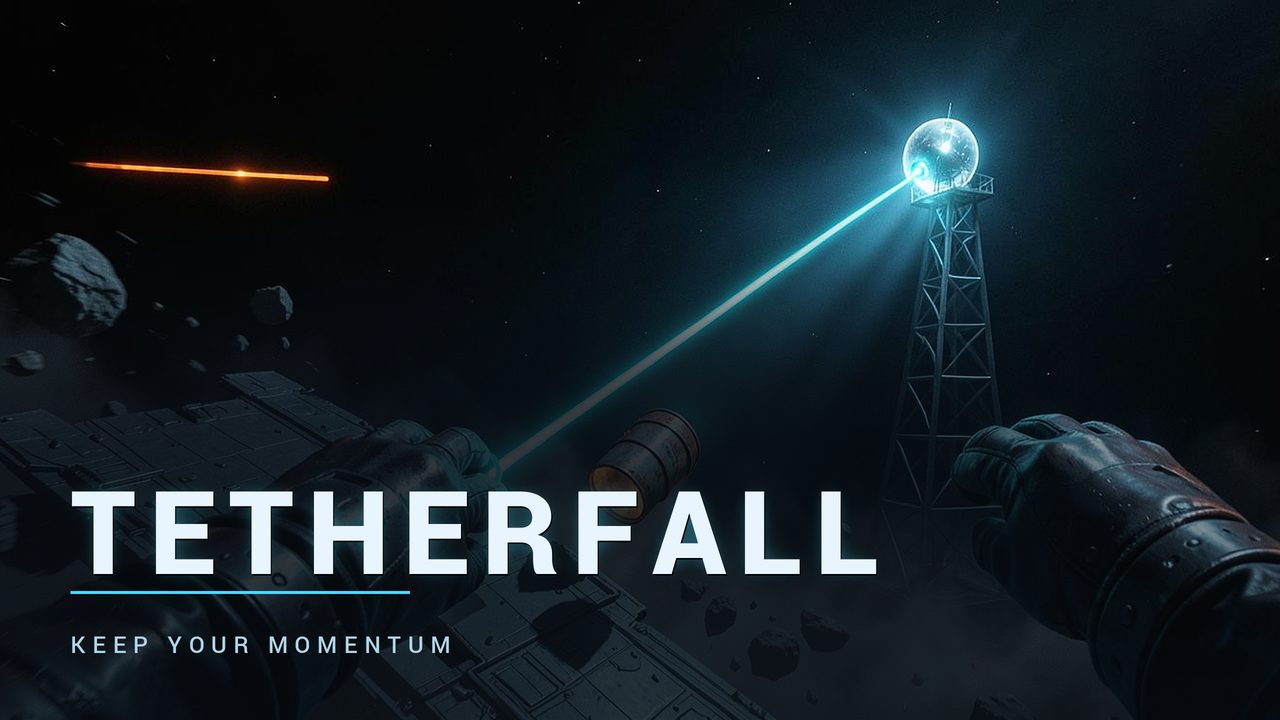
A zero-gravity salvage game built for VR. Nothing pushes you but your hands and a 45-metre line. Grapple the towers, swing through the wreck field, and get the cargo home before the ring runs dry.
You are a scavenger in a dead orbital yard. There is no walking and no throttle — just your hands, a spool of line, and whatever speed you can borrow from the wreckage.
Press a palm into a surface and shove. Hand speed becomes body speed, capped per push, so every launch is a read you have to make.
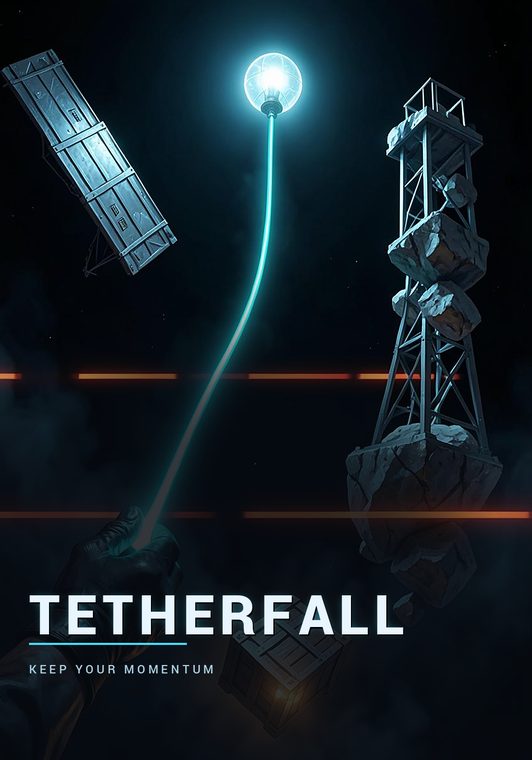
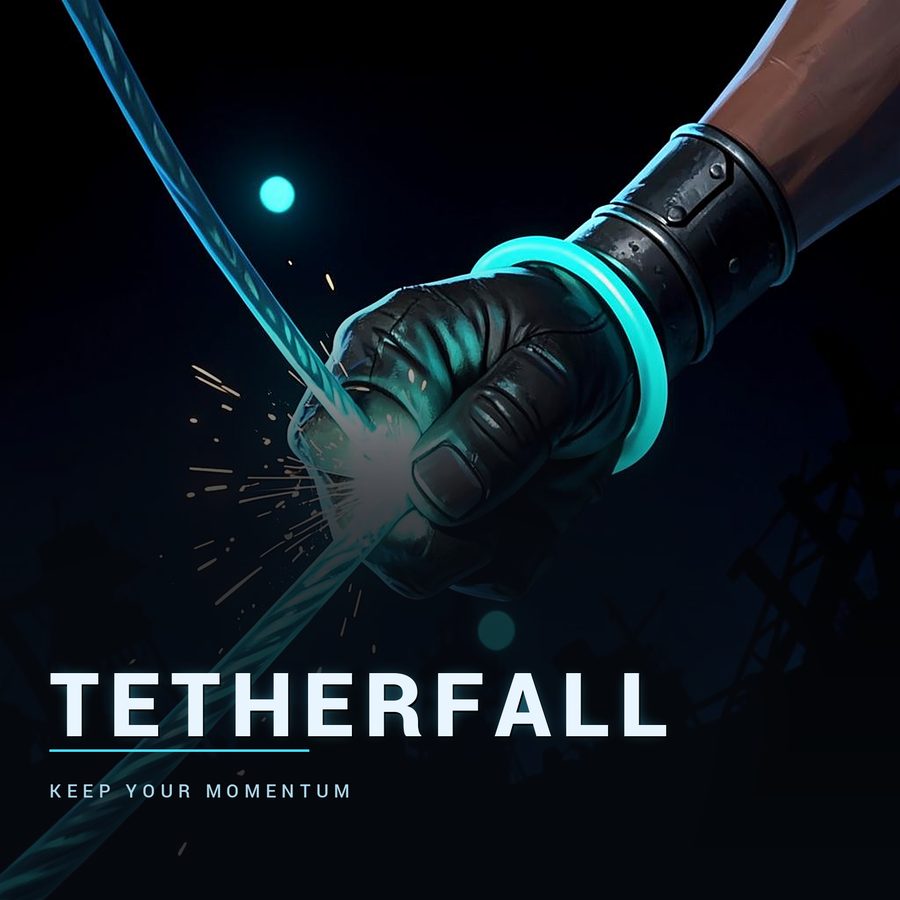
Fire the line at an anchor ring. Hold the arc, then reel the winch to turn a wide swing into a slingshot — the fastest way across the yard.
Pluck drifting salvage out of the dark with either hand. A cargo rack caps your hold; carry more and one bad swing costs more.
Fly the hopper to cash the hold into credits, spend them on the rig, and beat your best run time. Then go back out heavier.
The ring on your HUD is not a stamina bar you can stand still and refill. It drains whenever you slow below 2.6 m/s, and it only recovers above 4.6 m/s. Let it empty and you snap back to the launch pad — and everything in your hold stays out there in the dark.
The launch pad is the one place you can breathe. Stay docked and the ring refills; leave the dock and the clock starts with it.
Tether towers ring the yard, lit like lighthouses. Between them: shattered plating, drifting crates, vent plumes, and rotating debris that will not stop for you.
Credits go into the rig between runs. Every upgrade changes one number you can feel in the headset — no stat soup, no dead purchases.
More delta-v per push and a higher per-push cap.
Longer line, so towers you had to skip become anchors.
Faster reel and a stronger pull toward the anchor.
Two more hold slots per level. Bigger hauls, bigger losses.
Salvage near your gloves gets pulled into the grab.
Less drift, so a correction costs less speed.
Shorter grab cooldown for fast passes through a field.
A wider hopper radius — you can bank without stopping.
Tetherfall is a VR-first build. There is no flat-screen mode and no account requirement.
Short answers to the things people ask before putting a headset on.
No. Tetherfall starts a local guest profile so progress is kept on the headset. Meta platform sign-in is planned for release but the game does not require it to play.
It is single player. Every run in the yard is yours alone, and the only rival is your best time.
In a save file inside the game's own storage on your headset — credits, salvage count, upgrade levels, and your best run. Nothing is uploaded. Uninstalling the game or clearing its data removes the profile.
Yes. Seated play works, and reaching surfaces to push off is part of the design. Standing room-scale gives you more room to swing, but clear your play boundary either way.
The game is still in development and has no store listing or purchases. Any credits or upgrades in a development build are virtual, have no cash value, and may be reset as systems change.
Free movement in VR affects people differently. Tetherfall uses physical pushes, a tether, and a fixed 90 Hz simulation step rather than artificial sliding, but take breaks the moment you feel off. Full health guidance is in the Terms of Service.
Tetherfall is in active development for Meta Quest. There is no store page yet — if you want to test a build, ask, and you will get one before anyone else.